Horse Racing Odds Explained – Fractional, Decimal, SP, and the Bookmaker’s Edge
 Available in US
I spent my first year backing horses without genuinely understanding odds. I knew that 5/1 meant I would get five pounds for every one pound staked, but I had no idea what that number actually represented in terms of probability, why it differed between bookmakers, or how the bookie built their profit into every price on the board. That ignorance cost me money – not because I picked bad horses, but because I consistently accepted bad prices.
Horse racing odds are the language of the betting market, and in the UK, that language has its own dialect. While most European sportsbooks default to decimals and American books use moneylines, British racing runs on fractional odds – a format that dates back centuries and remains the standard across every racecourse and high-street bookmaker in the country. Pari-mutuel wagering, where all bets go into a shared pool, accounts for just 5% of UK racing turnover. The other 95% is fixed-odds betting between you and a bookmaker, and understanding how those odds are set, how they move, and where the bookmaker hides their margin is the difference between punting blind and punting with purpose. This is the foundation of any serious approach to horse racing betting in the UK.
Table of Contents
- Fractional Odds – The Language of UK Racing
- Decimal Odds and Converting Between Formats
- Starting Price – Who Sets It and Why It Matters
- Best Odds Guaranteed – How It Works and Why Every Punter Needs It
- The Tote and Pool Betting – UK’s Pari-Mutuel System
- The Overround – Finding Where the Bookmaker’s Margin Hides
- Why Odds Move and What Drifters and Steamers Tell You
- Odds and Pricing FAQ
Fractional Odds – The Language of UK Racing
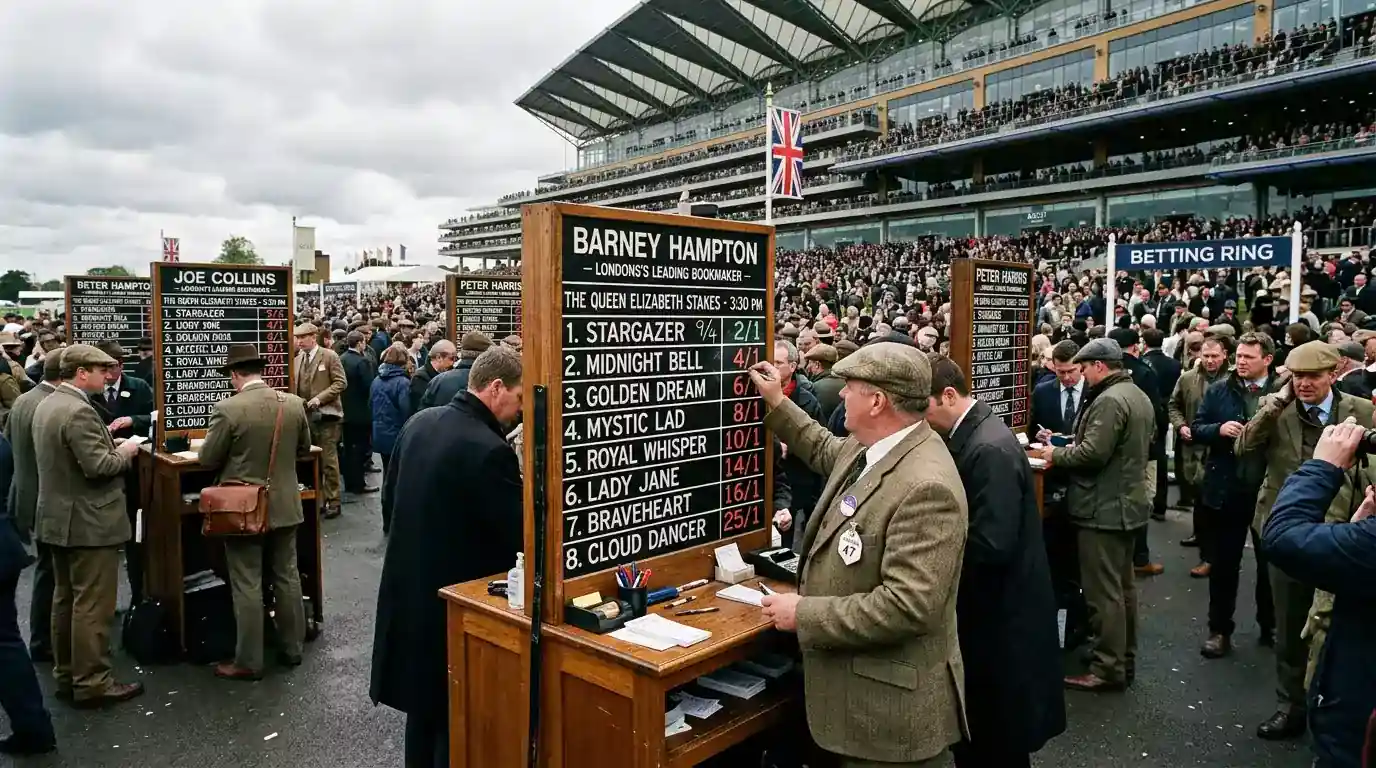
Stand at the rails at Cheltenham on Gold Cup day and the prices shouted by on-course bookmakers are all fractional. 5/2, 7/1, 11/4. It is the native tongue of British racing, and if you cannot read it fluently, you are betting at a disadvantage before the stalls even open.
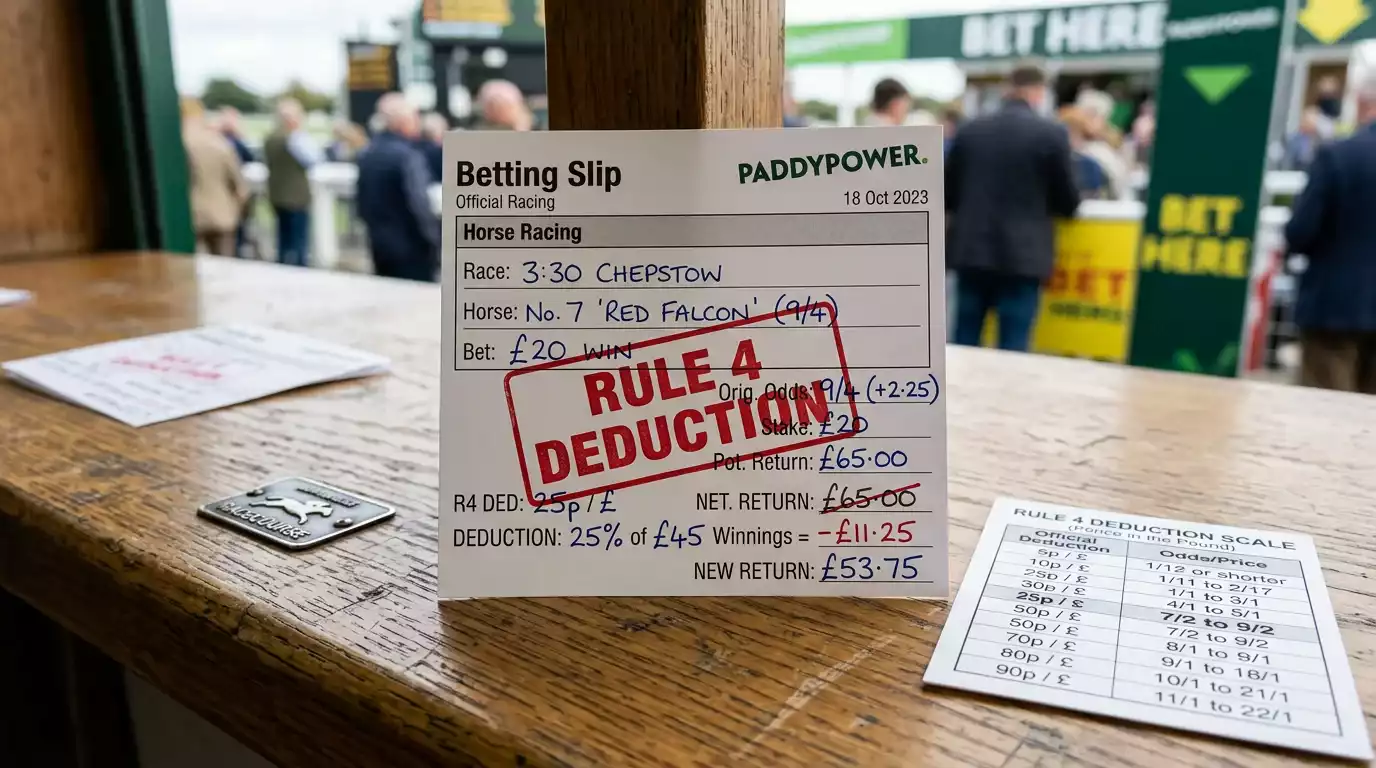
Fractional odds express the profit you stand to make relative to your stake. At 5/1, you win five pounds for every one pound wagered, plus your stake back – so a ten pound bet returns sixty pounds total. At 2/1, ten pounds returns thirty. The number on the left is your potential profit, the number on the right is the unit of stake. Simple enough when the fractions are clean, but UK racing loves awkward prices like 11/4, 9/2, and 100/30, which trip up newcomers constantly.
Here is the quick method I use for any odd-looking fraction. Divide the left number by the right, and that gives you the profit per pound. 11/4 means 11 divided by 4 = 2.75, so a one pound bet profits two pounds seventy-five. A ten pound bet at 11/4 returns 10 x 2.75 = 27.50 profit, plus the ten pound stake, for 37.50 total. 100/30 reduces to 10/3, which is 3.33 per pound. Once you get used to the division, fractional odds become instant.
The critical distinction is between odds-on and odds-against. Odds-against means the left number is larger than the right – 3/1, 9/4, 7/2 – and you profit more than you stake. Odds-on means the right number is larger – 4/5, 1/2, 2/7 – and you profit less than you stake. An odds-on favourite at 4/5 returns just eighty pence profit per pound risked, which means you need to be very confident in the horse to justify the risk-to-reward ratio. Even (or evens, written as 1/1 or EVS) is the midpoint: one pound profit per pound staked.
I spent years assuming that shorter odds always meant a better horse. They do not. Shorter odds mean the market thinks the horse is more likely to win, and the market is influenced by money, sentiment, and bookmaker liability – none of which are infallible guides to actual ability. The price reflects probability as perceived by the market, not probability as determined by nature. Understanding what odds tell you – and what they hide – feeds directly into choosing the right bet type for each situation.
Decimal Odds and Converting Between Formats
The first time I placed a bet on a betting exchange, I stared at the price “4.50” and had to mentally convert it back to fractional before I trusted what I was looking at. Decimal odds are the global standard outside the UK, and they are increasingly common on exchanges, European-facing bookmakers, and mobile apps that serve international audiences.
Decimal odds represent your total return per unit staked, including the stake itself. A decimal price of 4.50 means a one pound bet returns four pounds fifty in total – three pounds fifty profit plus your one pound stake back. The equivalent fractional price is 7/2. To convert fractional to decimal, divide the fraction and add one: 7 divided by 2 = 3.5, plus 1 = 4.5. To go the other direction, subtract one from the decimal and express as a fraction: 4.5 minus 1 = 3.5, which is 7/2.
The real power of decimal odds is in calculating implied probability – the percentage chance the price suggests. Divide one by the decimal odds and multiply by 100. At 4.50, the implied probability is 1 / 4.50 x 100 = 22.2%. At 2.00 (evens), it is 50%. At 1.50 (1/2), it is 66.7%. This conversion is essential for value betting because it lets you directly compare the bookmaker’s assessment of a horse’s chance with your own.
Exchanges default to decimal for a practical reason: when you are backing and laying at precise increments, decimals allow finer granularity. The difference between 5.0 and 5.1 in decimal (4/1 and roughly 41/10 in fractional) is easy to read and act on. Fractional odds do not handle that kind of precision gracefully – 41/10 is not a price any on-course bookie would shout. For exchange trading, where you might be moving in and out of positions during a race, decimal is simply the more functional format.
My recommendation for anyone serious about racing: learn to think in both. Read the racecard in fractional, assess value using implied probability, and trade on exchanges in decimal. The format is just a wrapper around the same underlying number – what matters is what that number tells you about the market’s view of the race.
Starting Price – Who Sets It and Why It Matters
Every horse racing bet you place references the Starting Price at some level, even if you never consciously choose to take it. SP is the final price available on a horse at the moment the race begins, and it serves as the default settlement price for any bet placed without specifying fixed odds. In a market generating over 766 million pounds in gross gambling yield annually, SP is the benchmark that holds the entire pricing system together.
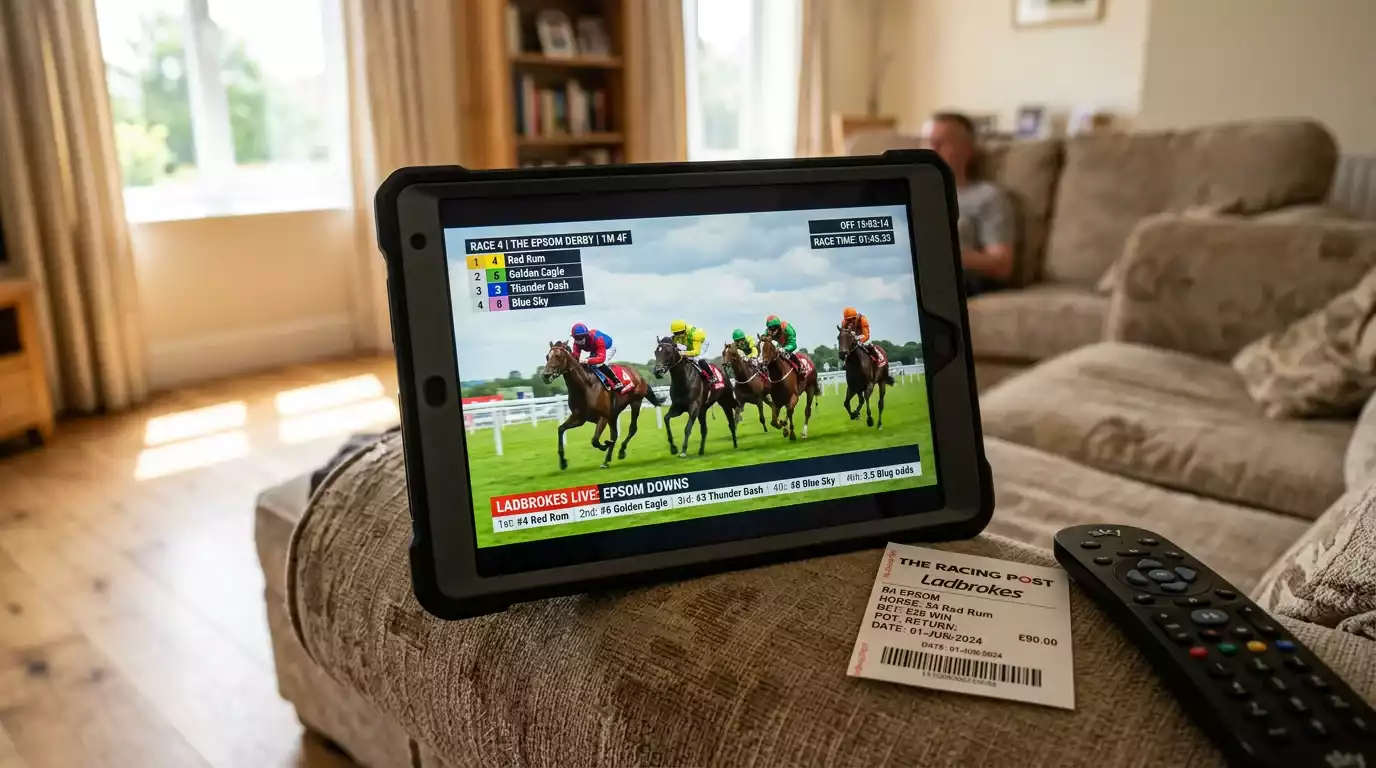
The SP is determined by SP reporters – officials employed by an independent body who stand in the on-course betting ring and record the prices offered by bookmakers just before the off. They assess the general odds available across the on-course market and return a consensus price. This is the industry SP, and it applies to bets where no fixed price was taken, including many bets placed in betting shops and those marked “SP” online.
There is a meaningful distinction between the industry SP and what individual bookmakers display as their final price. The industry SP reflects the on-course market, which can differ from online prices. On-course money tends to be sharper – professional punters and owners often bet on course – so the SP can sometimes be shorter (lower odds) than what was available online moments earlier. Conversely, if a horse drifts in the on-course ring due to last-minute concerns about the going or a rival’s appearance, the SP can be longer than the early online price.
When does taking SP make sense? In races where you expect the horse to shorten in the market – perhaps a well-fancied runner in a weak field – taking early fixed odds and letting BOG (Best Odds Guaranteed) protect you is the superior play. But in races where you anticipate the horse will drift – maybe it is overbet early due to name recognition or a big-stable label – waiting for SP can deliver a better price. The challenge is predicting market direction, which is itself a skill. Most experienced punters take early prices on horses they expect to shorten and let SP run on speculative picks where drift is likely.
One scenario where SP is virtually always worse: ante-post transitions. A horse backed at 20/1 ante-post three months ago that is now 5/1 on the morning of the race will return an SP somewhere in the 4/1 to 6/1 range. The ante-post punter locked in far superior value. SP is a convenience, not a strategy – and understanding when to avoid it is as important as knowing how it works.
Best Odds Guaranteed – How It Works and Why Every Punter Needs It
If someone offered you a free upgrade on every bet you placed, you would take it without hesitation. That is exactly what Best Odds Guaranteed does, and it baffles me how many punters either do not know it exists or do not structure their betting to maximise it.
BOG works like this: you take a fixed price on a horse – say 8/1 – and the SP comes back at 10/1. With BOG, the bookmaker pays you at 10/1, the higher price. If the SP had come back at 6/1, you keep your 8/1. You get the better of the two prices, every time. It is free insurance against taking an early price that turns out to be shorter than the market settles at, and it costs you absolutely nothing.
The conditions vary slightly between operators. Most apply BOG to UK and Irish racing only, starting from a certain time in the morning – typically around 9am or when the overnight prices go up. Some cap the maximum payout boost or restrict BOG to specific bet types. A handful do not offer it on ante-post bets. These details matter, and checking which terms apply at your bookmaker before you bet saves confusion later.
Grainne Hurst, CEO of the Betting and Gaming Council, has pointed out that contributions to British racing from regulated operators have reached record levels for the fourth consecutive year. Those contributions are funded by bookmaker profits, and BOG is one of the tools bookmakers use to attract and retain punters who generate that turnover. It is not charity – it is a competitive weapon – but it is one that genuinely benefits the bettor.
The strategic play with BOG is straightforward: take early prices whenever you have a view, because BOG removes the downside of being wrong about market direction. If the horse shortens, you have already locked in the bigger price. If it drifts, BOG upgrades you automatically. The only scenario where BOG does not help is when you take the early price and the horse does not shorten or drift – in which case BOG is neutral and you still have the price you wanted.
Punters who maintain accounts with multiple bookmakers consistently achieve 2-5% better returns than those using a single operator, and BOG is a significant contributor to that edge. Different bookmakers put up different early prices, and the one offering the longest morning price on your selection – combined with BOG – gives you the best of both worlds: the highest fixed price plus automatic upside if SP goes higher. This is not a complex strategy. It is basic arithmetic applied consistently, and over hundreds of bets, that 2-5% compounds into a meaningful difference.
The Tote and Pool Betting – UK’s Pari-Mutuel System
Walk into any UK racecourse and you will see two parallel betting systems operating side by side: the bookmakers’ pitches offering fixed odds, and the Tote windows running a pari-mutuel pool. Most punters gravitate to the bookies without a second thought, which is exactly why the Tote can occasionally offer extraordinary value to those who understand how it works.
Pari-mutuel betting – the system the Tote runs – pools all bets on a race together, deducts a percentage for operating costs and profit, and divides the remainder among winning bettors. The dividend (the pari-mutuel term for payout) is not known until after the race, because it depends on how much money was bet on each horse and the total pool size. This is fundamentally different from fixed odds, where you know your price the moment you place the bet.
The Tote offers several pool bet types. Win and Place are the simplest – back a horse to win or place, and your payout is a share of the respective pool. Exacta requires you to predict the first two in order, equivalent to a straight forecast. Trifecta requires the first three in order. These pool versions often pay dramatically more than their fixed-odds equivalents when an unfancied horse features in the result, because less money will have been bet on those combinations.
Then there are the big pool bets that have no fixed-odds equivalent. The Placepot asks you to pick a horse to place in each of the first six races on a card – a demanding challenge, but one that regularly produces five-figure dividends from modest stakes. The Scoop6 requires winners in six designated races across a Saturday card, and the jackpot rolls over if nobody lands it, sometimes building to enormous sums. These are lottery-scale bets with lottery-scale payouts, and they attract a specific type of punter who enjoys the communal, rolling nature of pool betting.
Pool betting accounts for roughly 5% of UK racing turnover – a tiny fraction compared to fixed odds, but that small pool size is precisely what creates opportunities. When the crowd piles money on a favourite in the Tote Win pool, the dividend on that favourite will be lower than the bookmakers’ SP. But the dividend on every other horse in the race gets pushed higher. In races where the favourite is overbet in the pool – which happens frequently at big festivals where casual punters bet with the Tote on course – backing an outsider through the pool can return significantly more than the fixed-odds equivalent.
The Overround – Finding Where the Bookmaker’s Margin Hides
Nobody talks about the overround at the pub, but it is the single most important number in any betting market. It is the bookmaker’s built-in margin – their guaranteed edge – and every price you take already has it baked in. Learning to spot it, calculate it, and work around it is what separates informed punters from everyone else.
The overround is calculated by converting every horse’s odds in a race to an implied probability and adding them up. In a perfectly fair market, those probabilities would sum to 100% – each horse’s chance reflecting its true likelihood of winning. In reality, they always sum to more than 100%. A typical UK horse race might have an overround of 115-120%, meaning the bookmaker has built in a 15-20% margin across the field. A five-runner race with tight odds might be as low as 108%. A big handicap with 20 runners can push past 130%.
Here is a practical example. Say a six-runner race has the following prices: 2/1, 3/1, 5/1, 8/1, 12/1, 20/1. Convert each to implied probability: 33.3%, 25%, 16.7%, 11.1%, 7.7%, 4.8%. Sum: 98.6%. Wait – that is under 100%. In practice, this almost never happens in bookmaker markets, but it does occasionally appear on exchanges where there is no institutional bookmaker setting prices. If you find a bookmaker market under 100%, you have found a genuine mathematical edge. More realistically, you are looking at a total around 115%, and your job is to identify which horses in the field are carrying more than their share of that overround – i.e., which horses are overpriced relative to their true chance.
A value bet exists when you believe a horse’s true probability of winning is higher than the implied probability suggested by its odds. If a horse is priced at 5/1 (implied probability 16.7%), but your assessment of the form, going, and race dynamics gives it a 25% chance, that is a value bet. You do not need to be right every time – you need to be right often enough that the higher implied probability you are backing outweighs the times you lose.
The overround also explains why some bookmakers consistently offer better value than others. A firm running a 112% book gives more back to punters than one running a 125% book. Over time, betting with lower-margin operators puts more money back in your pocket, even if the individual prices look similar on any given race. This is the quiet, unglamorous edge that professional punters exploit relentlessly.
Why Odds Move and What Drifters and Steamers Tell You
Fifteen minutes before the off, your 10/1 pick is suddenly 6/1. What happened? Did someone know something, or did one big bet from a single punter shunt the entire market? Understanding why odds move – and what that movement tells you – is the final piece of the odds puzzle, and it is one of the most misunderstood aspects of racing markets.
A steamer is a horse whose odds shorten rapidly in the lead-up to a race. The classic steamer scenario: a well-backed runner from a powerful yard, money arriving from informed sources, and the bookmakers cutting the price to limit their exposure. Not every steamer wins – far from it – but a horse that contracts from 12/1 to 6/1 in the final hour before a race is clearly attracting serious money, and that money often comes from people closer to the horse than you are.
A drifter moves in the opposite direction – its odds lengthen, often dramatically. A horse opening at 5/1 and drifting to 10/1 suggests that either money has arrived for its rivals (pushing their prices down and its price up by extension), or that negative information – a less-than-ideal warm-up, stable whispers about fitness, a jockey change – is filtering into the market. Drifters win less frequently than the original odds implied, but they are not automatic losers. Sometimes the market overreacts, and a horse that drifts from 5/1 to 8/1 on no meaningful new information represents better value at the longer price.
The timing of odds movement matters as much as the direction. Early morning moves – from overnight prices to the first show – often reflect stable money and well-informed ante-post punters adjusting their positions. Moves in the final ten minutes before the off are driven by on-course money and last-minute market activity. Late money tends to be sharper: the people betting on course in the final minutes have often seen the horse in the paddock, assessed the going, and formed a view that morning punters could not.
I track odds movement as one input among many, never the sole reason for a bet. A horse that steamers in from 8/1 to 4/1 might win, but at 4/1 it might no longer represent value even if you agree it has a strong chance. Conversely, a drifter that goes from 6/1 to 10/1 because money arrived for a flashy rival might now be the best value bet in the race. The movement tells you what the market thinks. Your job is to decide whether the market is right.
Odds and Pricing FAQ
What does SP mean on my betting slip?
SP stands for Starting Price – the final odds available on a horse at the moment the race begins. If you placed your bet at SP rather than taking a fixed price, your payout is calculated using this returned price. SP is determined by independent officials who assess the on-course bookmaker market just before the off.
How is the Tote dividend calculated?
The Tote pools all bets on a race together, deducts a percentage for operating costs (typically around 13-27% depending on the pool type), and divides the remainder among winning bettors proportionally to their stake. The dividend is not known until after the race because it depends on the total pool size and how much was bet on the winning outcome.
Do all bookmakers offer Best Odds Guaranteed on every UK race?
Most major UK bookmakers offer BOG on UK and Irish racing, but the terms vary. Some restrict it to bets placed after a certain time in the morning, some cap the maximum additional payout, and a few exclude certain bet types or markets. Always check the specific BOG terms at your bookmaker before relying on the upgrade.
Written by the editors at Horse Racing Game Betting.