Horse Racing Betting Strategy – Systems, Staking Plans, and Finding Value
 Available in US
Three years into my punting career, I added up every bet I had placed in a calendar year. The total was sobering: 847 bets, a turnover north of six thousand pounds, and a net loss of four hundred and twelve pounds. My selections were not the problem – my strike rate was respectable. The problem was everything else: inconsistent staking, chasing losses on the final race of a Saturday card, ignoring price in favour of opinion. I had no strategy. I was gambling, not betting.
Horse racing betting strategy is what separates the punters who survive from the ones who quietly stop. The UK racing betting market has contracted by over three billion pounds in real terms since 2022, squeezed by tighter regulation and shifting consumer habits. The days of easy money – if they ever existed – are definitively over. What remains is a market that rewards discipline, mathematical rigour, and a systematic approach to identifying and exploiting value. This is the framework I use, built over a decade of mistakes and adjustments, and it builds on the fundamentals covered in the UK horse racing betting guide.
Table of Contents
- Value Betting – The Only Strategy That Works Long-Term
- Staking Plans – Level Stakes, Percentage, and Kelly Criterion
- Exchange Betting – Back, Lay, and Trade Without a Bookmaker
- Dutching – Backing Multiple Horses to Guarantee Profit
- The Multi-Account Edge and Price Comparison
- Five Strategy Traps That Drain Racing Bankrolls
- Strategy FAQ
Value Betting – The Only Strategy That Works Long-Term
Every profitable punter I have met over twelve years shares one trait: they think in probabilities, not picks. They do not ask “will this horse win?” – they ask “is this horse more likely to win than the odds suggest?” That distinction is the entire foundation of value betting, and without it, no staking plan, no system, and no amount of form study will save your bank.
A value bet exists when the true probability of an outcome is higher than the implied probability of the odds offered. If you assess a horse as having a 25% chance of winning but the bookmaker prices it at 5/1 (implied probability 16.7%), the gap between your assessment and the market’s assessment is where value lives. You do not need to be right about every individual race. You need your probability assessments to be more accurate than the market’s over a large enough sample of bets.
The practical challenge is obvious: how do you determine a horse’s “true” probability? Nobody knows the actual number. What you can do is build an informed estimate by assessing form, going, class, trainer-jockey data, and the other racecard factors that influence results. If your analysis suggests a horse has a roughly one-in-four chance, and the market is pricing it as though it has a one-in-six chance, you have found value. The bookmaker has underestimated the horse relative to the field, and over time, backing those underestimations at those prices will produce a profit.
The key phrase is “over time.” Value betting does not eliminate losing runs. A horse with a genuine 25% chance still loses 75% of the time. You will back value bets that lose five, ten, fifteen times in a row before one lands. The temptation to abandon the approach during a cold streak is enormous, and most punters give in. The ones who do not – the ones who trust their process and maintain discipline – are the ones whose annual P&L finishes in the black.
I assess value against the morning prices, not the SP. By the time the market has settled into its final prices, the sharpest value has usually been taken. Early prices, combined with Best Odds Guaranteed, give you the widest window to identify and capture mispricing. If I cannot find value in the morning prices, I do not bet. Walking away from a race with no value is as much a strategic decision as backing a horse in one where value exists.
Staking Plans – Level Stakes, Percentage, and Kelly Criterion
Finding value gets you the edge. Staking correctly keeps you alive long enough to realise it. I learned this the hard way when I identified a genuine 20% edge over three months but still lost money because I was betting 10% of my bank on single races and one bad week wiped out six weeks of profit.
Level stakes is the simplest approach: you bet the same amount on every selection, regardless of odds or confidence level. One pound per bet, every bet, no exceptions. It is easy to track, removes emotional decision-making from the equation, and ensures no single losing bet damages the bank disproportionately. The downside is that it treats every bet equally, which means you stake the same on a 2/1 shot you love as on a 10/1 longshot you merely like. For punters starting out, level stakes is the safest foundation.
Percentage staking adjusts the bet size relative to your current bank. Instead of a fixed amount, you bet a fixed percentage – typically 1-3% – of whatever your bank currently stands at. When the bank grows, your bets grow with it. When it shrinks, your bets shrink too, providing a natural braking mechanism during losing runs. A 500-pound bank at 2% means ten-pound bets. If the bank drops to 400, bets drop to eight pounds. If it grows to 700, bets rise to fourteen. The percentage keeps you proportionate, which is far more important than most punters realise.
The Kelly Criterion takes staking a step further by calculating the optimal bet size based on your perceived edge and the odds offered. The formula is: (probability x odds – 1) / (odds – 1), where probability is your assessment and odds are in decimal format. If you rate a horse as having a 30% chance at odds of 4.0, Kelly says to stake (0.30 x 4.0 – 1) / (4.0 – 1) = 0.2 / 3 = 6.7% of your bank. It maximises long-term growth when your probability estimates are accurate.
The problem with Kelly is the word “accurate.” Overestimate your edge by even a few percentage points and Kelly will tell you to overstake, accelerating losses instead of growth. This is why most professional punters use fractional Kelly – half Kelly or quarter Kelly – which retains the proportional scaling but builds in a safety margin for estimation error. I use quarter Kelly as my default. It means slower growth during winning periods, but it also means I have never blown a bank, and in twelve years of backing horses, that survival is the foundation everything else is built on.
Exchange Betting – Back, Lay, and Trade Without a Bookmaker
Nevin Truesdale, when he was running the Jockey Club, said something that stuck with me: the regulator seemed to want to reduce gambling to just small-stakes punters, and that approach was pushing serious bettors toward alternatives. One of those alternatives is the betting exchange, and for punters whose accounts have been restricted or who simply want a fairer market structure, exchanges represent a fundamentally different way to bet on racing.
A betting exchange is a marketplace where punters bet against each other rather than against a bookmaker. There are two sides to every transaction: the backer, who bets on a horse to win (just like a traditional bet), and the layer, who bets against a horse winning (effectively acting as the bookmaker). The exchange matches these opposing positions and takes a commission on winning bets – typically 2-5% depending on the platform and your activity level.
The mechanics are straightforward. You see two columns of prices for each horse: the back price (what you can bet at if you think the horse will win) and the lay price (what you can bet at if you think it will not win). The back price is always slightly lower than the lay price, and this gap – the spread – is the exchange’s version of the bookmaker’s overround. In liquid markets, the spread is tiny. In thin markets, it can be wide.
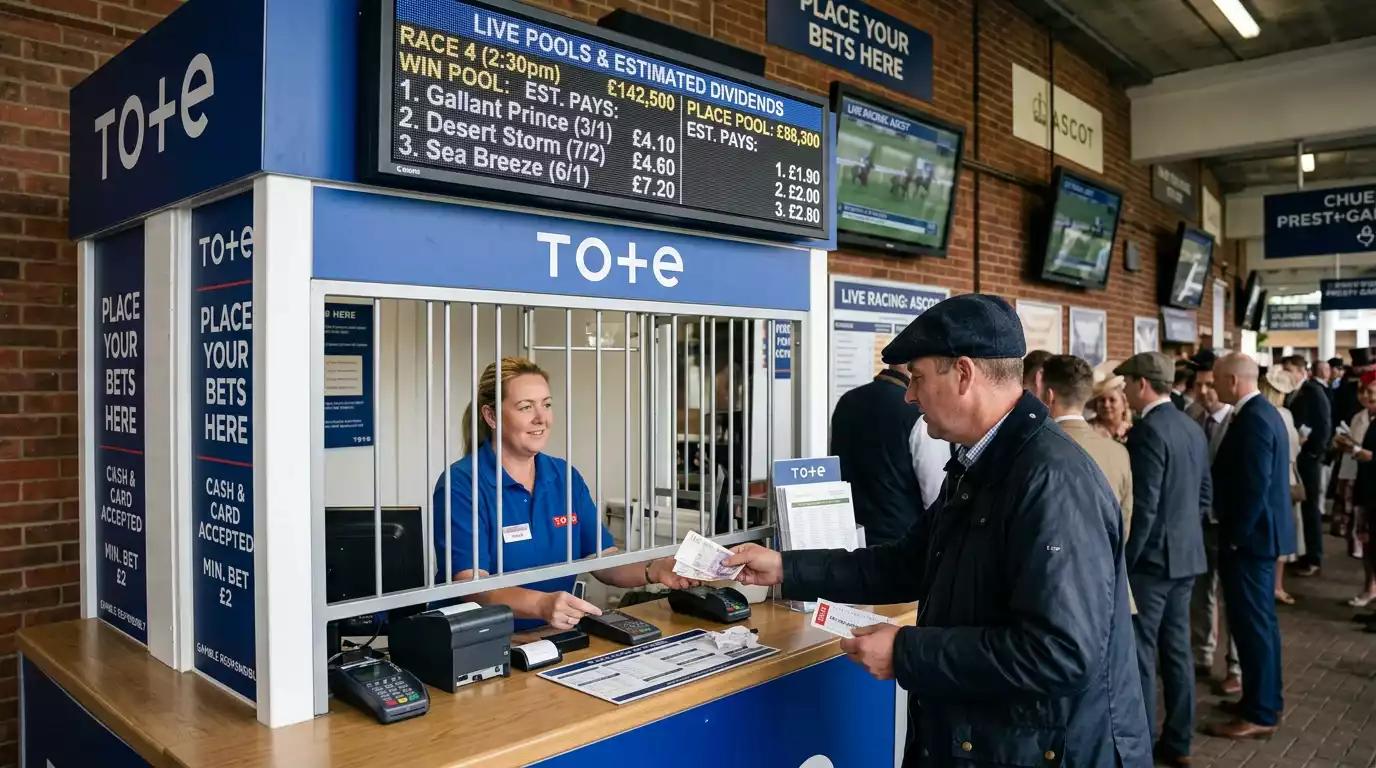
Pari-mutuel pools account for about 5% of UK racing turnover, and traditional fixed-odds bookmakers dominate the rest. The exchange sits as a third model – one where the odds are determined purely by supply and demand rather than by a bookmaker’s risk management or by a pool calculation. This produces some distinctive advantages. Exchange odds are frequently better than bookmaker odds on popular runners because the competitive marketplace drives prices closer to true probability. There is no bookmaker deciding to cut your limits or restrict your account because you win too often. And the ability to lay – to bet against a horse – opens strategic possibilities that simply do not exist with a traditional bookmaker.
In-running trading takes exchange betting further. You can back a horse before the race and lay it during the race (or vice versa) to lock in a profit regardless of the final result – a technique called “greening up.” If you back a horse at 6.0 before the off and it is travelling well at 3.0 in-running, you can lay it at 3.0 and guarantee a profit whether it wins or loses. This is closer to financial trading than traditional betting, and it rewards a different skill set: the ability to read a race in real time and react to how it unfolds.
The commission structure is the trade-off. On a traditional bookmaker bet, you pay nothing explicit – the margin is hidden in the odds. On an exchange, you pay commission on net winnings, which is visible and transparent but reduces your effective return. For punters who win regularly, the commission is worth paying because the better odds and freedom from account restrictions more than compensate. For casual punters placing occasional bets, the difference is marginal.
Dutching – Backing Multiple Horses to Guarantee Profit
Can you back three horses in the same race and still make a profit? Yes – if the combined odds of your selections exceed what the bookmaker expects. Dutching is the strategy of splitting your stake across multiple runners in a single race, calculated so that whichever of your selections wins, you return the same profit. It sounds like a bookmaker’s nightmare, and when the conditions are right, it is.
The principle is simple. If you believe the race will be won by one of three horses and the combined implied probabilities of those three horses are less than 100% (meaning their odds are collectively generous), you can back all three at stakes proportional to their odds and guarantee a profit regardless of which one wins. The formula calculates the stake for each horse based on its odds relative to the total pool of selections, ensuring equal returns.
Here is an example. Three horses are priced at 3/1, 5/1, and 8/1. Their implied probabilities are 25%, 16.7%, and 11.1% – totalling 52.8%. Since this is well under 100%, dutching all three is mathematically viable. On a total outlay of 20 pounds, you would stake approximately 10.39 on the 3/1 shot, 6.93 on the 5/1, and 4.34 on the 8/1, returning roughly 41.50 regardless of which one wins. Your profit is 21.50 on a 20 pound outlay, but only if one of the three actually wins.
That last point is the catch. Dutching does not eliminate risk – it eliminates risk within your selected group. If none of your three selections win, you lose the entire stake. The more horses you include, the more likely one of them wins, but the thinner your margin becomes as you add more implied probability. The sweet spot is two or three strong selections where you have genuine form-based reasons to believe the winner comes from your group, and the odds collectively underestimate their combined chance.
Dutching works best in races where you can confidently eliminate most of the field. A 12-runner handicap where you rate three horses as serious contenders and the rest as makeweights is ideal. A wide-open 20-runner race where any of ten horses could win is not – the probability of an outsider beating all three of your dutched selections is too high, and the margin evaporates.
The Multi-Account Edge and Price Comparison
I back the same horse at three different bookmakers’ prices roughly once a week. Not the same bet placed three times – I compare prices and bet with whichever operator offers the best odds. This is not a secret technique. It is the most basic form of price shopping, and yet most punters never do it because they are loyal to a single bookmaker out of habit or convenience.
The data is clear: maintaining accounts at two or three bookmakers regularly delivers 2-5% better returns compared to a single operator. That number might sound small, but over a year of consistent betting it compounds into a significant sum. If your annual turnover is 5,000 pounds, a 3% improvement puts 150 pounds back in your pocket – money that was there for the taking and you left on the table because you could not be bothered to open a second tab.
Price comparison is most effective in the morning market, when bookmakers put up their early prices for the afternoon’s racing. At this stage, different operators often disagree on the correct price for a horse by one or two points of odds. A horse might be 9/2 with one bookmaker and 5/1 with another. Over time, consistently taking the 5/1 instead of the 9/2 is the difference between a profitable year and a losing one.
There is a secondary benefit beyond price. Different bookmakers offer different Best Odds Guaranteed terms, different each way place terms in certain races, and different promotional offers. A bookmaker running extra place terms on a big handicap is offering genuine additional value that its competitors are not. A free bet offer on new customers is a risk-free opportunity to add to your bankroll. None of these advantages are available to the single-account punter.
The time cost is negligible. Checking three prices before placing a bet takes less than a minute. The financial cost of maintaining multiple accounts is zero. The only reason not to do it is inertia, and inertia is not a strategy.
Five Strategy Traps That Drain Racing Bankrolls
Problem gambling affects 0.4% of the UK adult population – roughly 300,000 people – and among those who bet on horse racing, the rate is 2.8%. These numbers are lower than the industry average, but they are not zero, and every strategy trap on this list creates the conditions where recreational betting can slide into something harmful. Recognising these patterns is as much about protecting your wellbeing as protecting your bankroll.
Trap one: chasing losses. The 4:30 at Kempton is not going to fix a bad day. Yet the urge to recover earlier losses by increasing stakes on the last race of the card is the most common leak in any punter’s game. Chasing turns a controlled loss into an uncontrolled one and violates every staking principle worth following. The discipline is simple: if you have hit your daily loss limit, you stop. Tomorrow is another card.
Trap two: betting on every race. A typical Saturday card features 40+ races across multiple meetings. The temptation to have a bet in each one is strong, especially when you are watching and have time to kill. But most races do not contain value. A serious punter might find genuine value in three or four races on a full Saturday. The rest are entertainment, and betting on entertainment with the same stakes you use for value bets is a slow drain.
Trap three: ignoring the going. I covered this in the form guide, but it bears repeating as a strategy error because it is the most common oversight I see. Punters who spend twenty minutes studying form figures and trainer stats but do not check the ground conditions are building their analysis on an unstable foundation. Going is the single fastest filter for eliminating non-contenders, and skipping it is laziness, not strategy.
Trap four: following tipsters blindly. Tipsters exist to generate content, traffic, and in many cases affiliate revenue. Some are knowledgeable, many are not, and none have a strike rate that justifies abandoning your own analysis. Using a tipster as one input among several is reasonable. Outsourcing your entire betting strategy to someone else’s selections is not strategy at all – it is delegation, and you cannot evaluate what you do not understand.
Trap five: overbetting relative to bank. A 100-pound bank does not support five-pound stakes across eight races on a Saturday. That is 40% of your capital at risk in a single afternoon, and one bad day – which will come – puts you in a hole that percentage staking cannot climb out of. Size your bets to survive the losing runs, not to maximise the winning ones. The bank is the engine. Blow the engine and nothing else matters.
Strategy FAQ
What is the Kelly Criterion and should I use it for horse racing?
The Kelly Criterion is a formula that calculates the optimal stake size based on your perceived edge and the odds offered. It maximises long-term bankroll growth when probability estimates are accurate. Most experienced punters use fractional Kelly – typically quarter or half Kelly – because full Kelly requires perfect probability assessments, and overestimating your edge leads to overstaking and accelerated losses.
How many bookmaker accounts do I need for effective price comparison?
Three accounts is the practical sweet spot. Two gives you a meaningful price comparison on most races, and three covers the vast majority of pricing discrepancies in the UK market. Beyond three, the marginal benefit diminishes because prices across the major operators tend to converge, and the time spent checking additional accounts outweighs the occasional extra tick of value.
Can you make a consistent profit betting on horse racing?
It is possible but difficult. Consistent profit requires a systematic approach to identifying value, disciplined staking, emotional control during losing runs, and a willingness to walk away from races without value. The majority of recreational punters lose over time because they lack one or more of these elements. Those who treat it as a skill-based discipline rather than entertainment can achieve long-term profitability, but it demands genuine effort and continuous improvement.
Published by the Horse Racing Game Betting team.