Horse Racing Betting Tax in the UK – What Punters and Bookmakers Pay
 Available in US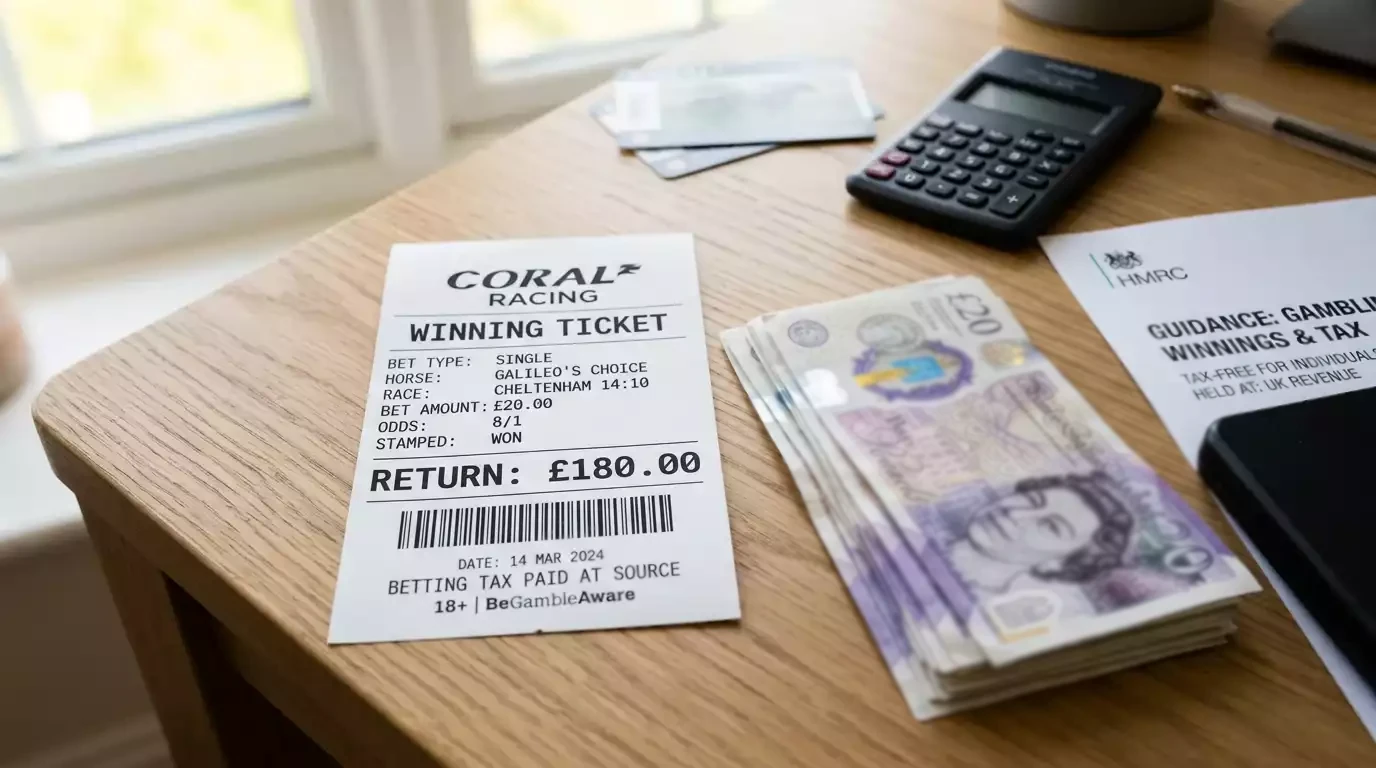
A colleague in his fifties once told me he still mentally deducts 9% from his winnings. Old habit – from the days when every punter in Britain paid betting duty on every bet. He’d grown up with it, and even though the tax was abolished in 2001, his brain still runs the calculation. That pre-2001 world, where the government took a slice of your winnings before you saw them, shaped an entire generation’s relationship with betting. The current system is radically different, and most punters don’t fully appreciate how good they’ve got it.
The 2001 Switch – Why UK Punters No Longer Pay Betting Tax
Until October 2001, UK punters paid a 9% general betting duty on either their stake or their winnings – you chose which at the point of the bet. Most chose the stake option, paying 9p on every pound wagered, because the alternative – paying 9% of your winnings – was more expensive if you won at anything above evens. The duty was visible on every betting slip: stake your GBP10, pay 90p duty, total cost GBP10.90.
The problem wasn’t the principle; it was the competition. By the late 1990s, offshore bookmakers – based in tax-free jurisdictions like Gibraltar and the Isle of Man – were offering duty-free betting to UK customers via the internet. British punters were migrating offshore in significant numbers, taking their money beyond the reach of UK taxation and regulation. The Treasury was losing revenue, and the regulated industry was losing customers.
Gordon Brown’s solution, implemented in the 2001 Budget, was elegant: abolish betting duty for punters entirely and replace it with a tax on the bookmaker’s gross profits. Punters stopped paying any tax on their bets. Bookmakers started paying tax on what they earned. The offshore incentive evaporated overnight, because the punter’s cost of betting in the UK dropped to zero in tax terms. Money flowed back onshore, the regulated market grew, and the Treasury recouped its revenue from the operator side.
The switch was transformative. It made UK horse racing betting among the most tax-efficient in the world from the punter’s perspective. Your GBP10 stake goes entirely on the horse. Your GBP50 winnings come back to you whole. No deductions, no duty, no tax line on the slip. Twenty-five years later, it remains one of the most punter-friendly tax regimes globally.
Point of Consumption Tax – What Bookmakers Pay
The replacement for punter betting duty is the point-of-consumption (POC) tax, which is charged on the gross gambling yield (GGY) of any operator serving UK customers, regardless of where the operator is based. The current rate is 21% of GGY. If a bookmaker takes GBP1 million in bets on horse racing and pays out GBP850,000 in winnings, the GGY is GBP150,000, and the tax is GBP31,500.
The total GGY across the remote casino, betting, and bingo sector reached GBP7.8 billion in the 2024-25 financial year, of which remote betting (including horse racing) contributed GBP2.6 billion. The 21% POC tax on these figures represents a substantial revenue stream for the Treasury – billions of pounds annually from the regulated gambling sector.
The 21% rate was increased from the original 15% in stages, most recently in the October 2024 Budget which raised it from 21% to its current level. Each increase squeezes bookmaker margins, which has knock-on effects: operators may widen the overround on their odds (making prices less generous for punters), reduce promotional offers, or cut costs elsewhere. The punter doesn’t see the POC tax on their slip, but they feel it indirectly through the prices they’re offered.
One important distinction: the POC tax applies to all gambling products, not just horse racing. A bookmaker’s racing GGY, casino GGY, and sports betting GGY are all taxed at the same rate. The racing industry has argued that horse racing’s unique contribution to British culture and economy should warrant a lower tax rate on racing-specific GGY, but this argument has not yet prevailed.
How the Levy and Tax Interact
The Horserace Betting Levy and the POC tax are separate obligations that both apply to bookmaker profits from horse racing. The Levy – 10% of profits above GBP500,000 specifically from British racing – funds the sport directly. The POC tax – 21% of GGY from all gambling activities – goes to the Treasury. A bookmaker’s profits from horse racing are therefore subject to both charges.
The Levy yielded a record GBP109 million in 2024-25, while the POC tax generates billions across the entire gambling sector. The interaction between these two charges means that horse racing is effectively double-charged relative to other betting products – the Levy applies only to racing, not to football, tennis, or casino. This additional cost is one reason why some operators have reduced their focus on horse racing as a product, allocating marketing spend and development resources toward sports and casino products that carry only the POC tax burden.
For the punter, the practical effect is that horse racing odds carry a heavier cost base than odds on other sports. The bookmaker must fund both the Levy and the POC tax from its racing margins, which translates into slightly wider overrounds on horse racing compared to equivalent football or tennis markets. This is invisible on any individual bet but contributes to horse racing’s reputation as a market where the bookmaker’s edge is fractionally higher.
Are Your Horse Racing Winnings Truly Tax-Free?
Yes – with an important clarification. Winnings from gambling are not subject to income tax, capital gains tax, or any other direct tax in the UK. This applies to all punters, whether you bet once a year on the Grand National or every day across multiple meetings. The legal basis is clear: gambling winnings are not classified as income under HMRC’s rules, and no tax liability arises from a winning bet.
The clarification is for professional punters – those who derive their primary income from betting. Even here, HMRC’s position has consistently been that gambling winnings are not taxable, because gambling is not considered a trade. The distinction between a “professional punter” and a “recreational punter who happens to win a lot” is legally irrelevant for tax purposes. Winnings are winnings, and they’re not taxed.
There are edge cases. If you operate a tipping service, sell selections, or run a syndicate where you charge management fees, the income from the service is taxable – but the underlying betting winnings remain tax-free. If you trade on a betting exchange in a manner indistinguishable from financial trading, HMRC could theoretically argue the activity constitutes a trade, but this has not been tested extensively and the prevailing view is that exchange trading remains within the gambling exemption.
The tax-free status of winnings is one of the most significant advantages UK punters have over bettors in many other countries. In the United States, gambling winnings are taxable income. In several European countries, winnings above certain thresholds are taxed. The UK’s approach – taxing the operator rather than the customer – keeps the punter’s returns clean and undiluted, which is one reason why the UK remains the most attractive regulated betting market in the world for horse racing.
Do professional punters pay tax on horse racing winnings?
No. Under current UK tax law, gambling winnings are not classified as taxable income regardless of whether you are a recreational or professional punter. HMRC does not consider gambling to be a trade, so no income tax or capital gains tax applies to winnings. However, if you earn money from selling tips, running a tipping service, or charging fees for syndicate management, that service income is taxable even though the underlying betting winnings are not.
Has the point-of-consumption tax rate changed since it was introduced?
Yes. The POC tax was introduced in December 2014 at a rate of 15%. It was subsequently increased to 21% in stages, with the most recent increase taking effect following the October 2024 Budget. Each increase has been met with concern from the gambling industry, which argues that higher tax rates squeeze margins and reduce the competitiveness of the regulated UK market relative to unlicensed alternatives.
Created by the ”Horse Racing Game Betting” editorial team.