
Horse Racing Odds Calculator – How to Calculate Returns, Payouts, and Value
 Available in US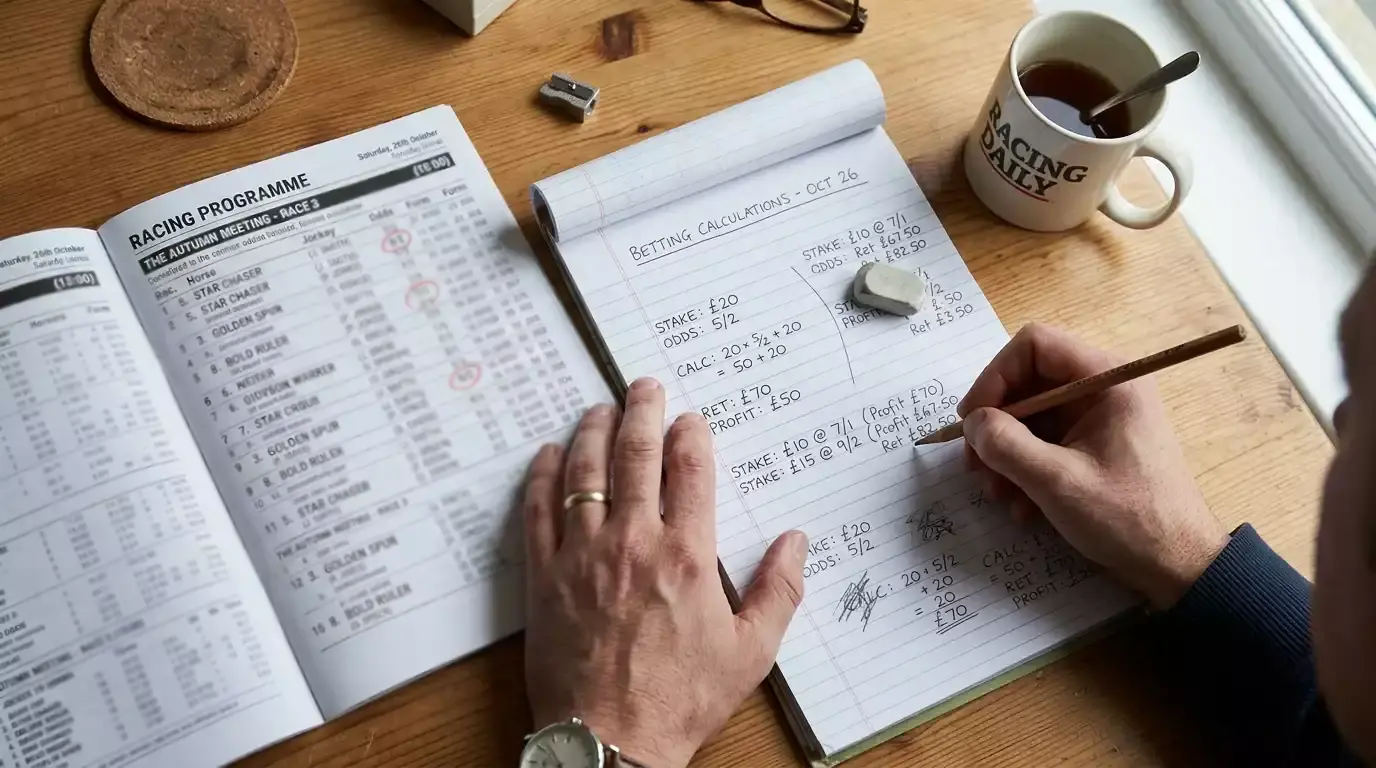
I spent the first two years of my betting life using online calculators every time I wanted to know what my bet would pay. Then one afternoon at Cheltenham, with no signal on my phone and a horse about to go off at 11/2, I couldn’t work out whether GBP15 each way was within my budget. I stood there like an idiot while the race started without me. That was the afternoon I learned to do the maths in my head, and it’s a skill that has saved me money, time, and embarrassment ever since.
The formulas behind horse racing returns aren’t complicated. Once you understand the logic, you can calculate any bet type – win, each way, accumulator, implied probability – in seconds without touching a screen.
Win Bet Returns – The Basic Formula
The win bet formula is the foundation everything else builds on. In fractional odds: Return = Stake x (Numerator / Denominator) + Stake. At 5/1 for GBP10: Return = 10 x (5/1) + 10 = GBP60. Profit = GBP50. At 7/2 for GBP10: Return = 10 x (7/2) + 10 = 10 x 3.5 + 10 = GBP45. Profit = GBP35.
In decimal odds, it’s even simpler: Return = Stake x Decimal Odds. A 5/1 shot is 6.0 in decimal. GBP10 at 6.0 = GBP60 return. The decimal already includes your stake, which is why decimal odds are always 1.0 higher than you might expect – evens (1/1) is 2.0, not 1.0.
Odds-on bets trip people up because the fraction is reversed. At 4/7 for GBP10: Return = 10 x (4/7) + 10 = 10 x 0.571 + 10 = GBP15.71. You’re risking GBP10 to profit GBP5.71. Favourites win about 33% of UK races, but odds-on favourites need to win substantially more often than that for the returns to cover the risk – which is why blind favourite-backing is a losing strategy despite the higher individual strike rate.
The mental shortcut I use for fractional odds: for odds above evens, the first number is your profit per unit of the second number. 9/2 means GBP9 profit per GBP2 staked, or GBP4.50 per GBP1. For odds below evens, flip the logic: 4/9 means GBP4 profit per GBP9 staked, or about 44p per GBP1. With practice, these conversions become instant.
Each Way Returns – Calculating Both Halves
Each way returns require two separate calculations because each way is two separate bets. The win part calculates at full odds. The place part calculates at a fraction of the odds, typically 1/4 or 1/5 depending on the race type and field size.
Example: GBP5 each way at 10/1, place terms 1/4 odds for three places. Total stake: GBP10 (GBP5 win + GBP5 place). If the horse wins: Win return = 5 x (10/1) + 5 = GBP55. Place return = 5 x (10/4) + 5 = 5 x 2.5 + 5 = GBP17.50. Total return: GBP72.50. Net profit: GBP62.50.
If the horse places (second or third) but doesn’t win: Win return = GBP0. Place return = GBP17.50. Total return: GBP17.50 from a GBP10 total stake. Net profit: GBP7.50.
At 1/5 odds place terms (used in some races): the same 10/1 horse would pay GBP5 x (10/5) + 5 = 5 x 2 + 5 = GBP15 for a place. The fractional difference between 1/4 and 1/5 terms seems small but compounds meaningfully across a season of each way bets.
Accumulator Returns – Compounding Across Legs
Accumulator returns compound by multiplying the decimal odds of each leg. A treble at 3/1, 5/2, and 4/1 in decimal is 4.0 x 3.5 x 5.0 = 70.0. At a GBP5 stake, the return is GBP350 (profit GBP345).
The mental approach for fractional odds: convert each leg to decimal first. 3/1 = 4.0. 5/2 = 3.5. 4/1 = 5.0. Multiply them all together, then multiply by your stake. This method works for any number of legs and avoids the confusion of trying to multiply fractions.
Holding accounts with multiple operators and comparing prices before building an accumulator delivers 2-5% better returns over a season. That margin is amplified on accumulators because the compounding effect magnifies even small differences at each leg. Backing leg one at 4/1 instead of 7/2 – a difference of one tick – increases a four-fold payout by roughly 14%. Over dozens of accumulators, these ticks add up to meaningful profit.
One calculation punters forget: the implied probability of landing the full accumulator. Multiply the implied probability of each leg together. A four-fold of 3/1 shots has an implied probability of 0.25 x 0.25 x 0.25 x 0.25 = 0.39%, or roughly 1 in 256. Even a four-fold of 2/1 favourites is only 3.7% – about 1 in 27. These numbers should inform your staking, not your excitement.
Implied Probability – Converting Odds to Percentage
Implied probability is the most underused tool in a punter’s kit. It converts odds into a percentage chance, which lets you compare your own assessment of a horse’s probability against the bookmaker’s. If your assessment is higher than the implied probability, the bet has value. If it’s lower, it doesn’t.
The formula for fractional odds: Implied Probability = Denominator / (Numerator + Denominator) x 100. At 4/1: 1 / (4+1) x 100 = 20%. The bookmaker is saying this horse has a 20% chance of winning. At 7/2: 2 / (7+2) x 100 = 22.2%. At evens: 1 / (1+1) x 100 = 50%.
For decimal odds, it’s even cleaner: Implied Probability = (1 / Decimal Odds) x 100. At 5.0: (1/5) x 100 = 20%. At 3.0: (1/3) x 100 = 33.3%.
The critical insight: the sum of all implied probabilities in a race exceeds 100%. A typical horse racing market might sum to 115-125%. The excess is the bookmaker’s overround – the built-in margin that ensures the book is profitable regardless of the result. If you can consistently identify horses whose true probability exceeds their implied probability by more than the overround, you’ve found a long-term edge against the market.
How do I calculate the return on a dead-heat?
In a dead-heat, your bet is settled at half the original odds. If your horse dead-heats for first at 6/1 for a GBP10 stake, the return is calculated as: half stake at full odds plus half stake returned. That is GBP5 x 6/1 = GBP30 profit, plus GBP5 stake returned on the winning half, plus GBP5 stake lost on the void half. Total return: GBP35 from a GBP10 stake. The same principle applies to place dead-heats on each way bets.
What is the formula for converting fractional odds to decimal?
Decimal Odds = (Numerator / Denominator) + 1. For 5/1: (5/1) + 1 = 6.0. For 7/2: (7/2) + 1 = 4.5. For 11/4: (11/4) + 1 = 3.75. For odds-on fractions like 4/7: (4/7) + 1 = 1.571. The +1 represents the return of your stake, which is included in decimal odds but not in fractional.
Written by the editors at Horse Racing Game Betting.