
Flat vs National Hunt Racing – How Two Codes Shape UK Horse Racing Betting
 Available in US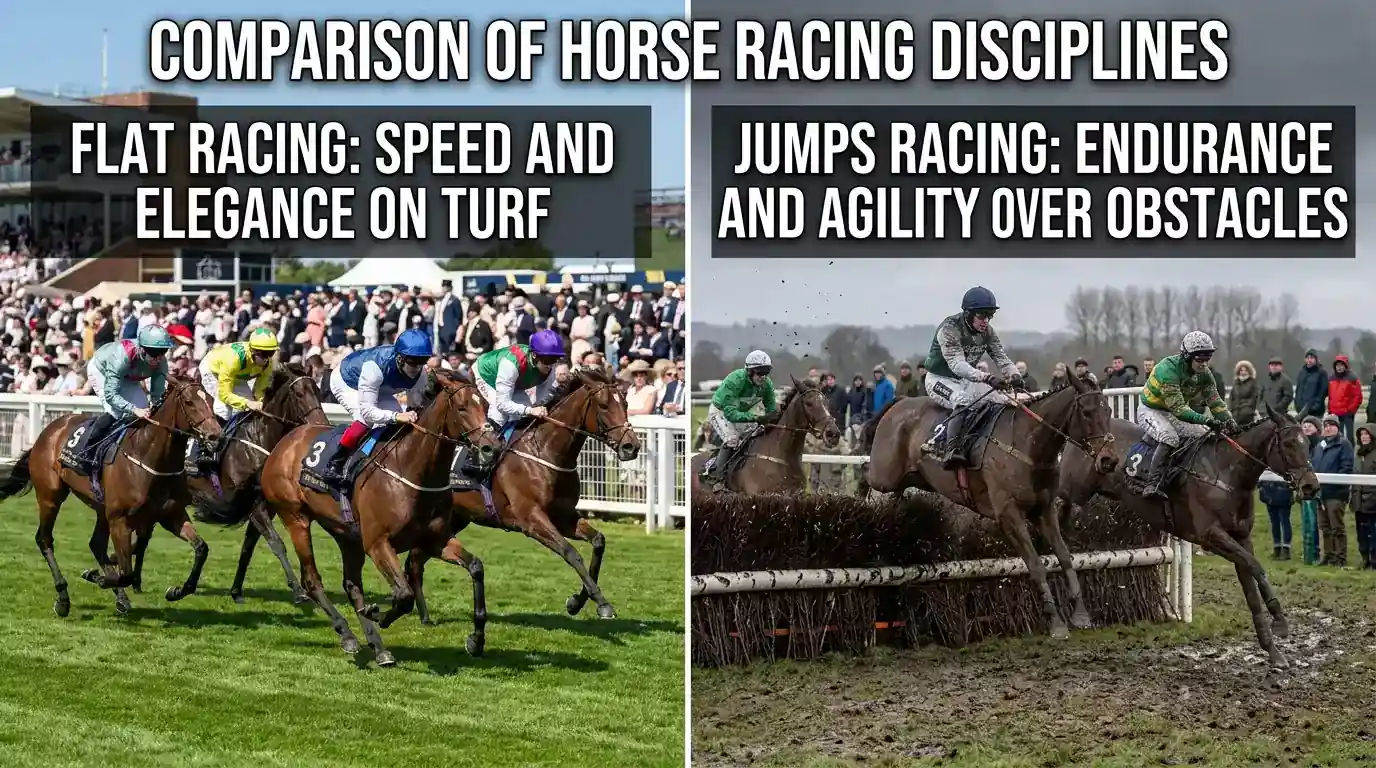
When I started betting on racing, I treated Flat and National Hunt as the same sport with slightly different scenery. Flat had shorter races, NH had jumps, and otherwise the principles were identical. It took about two losing months in the autumn – when the codes overlap and the temptation to apply Flat logic to jumps racing is strongest – to understand that they’re essentially two different sports sharing the same grass. The horses are different, the seasons are different, the form factors are different, and the betting dynamics diverge in ways that demand a complete mental reset when you switch between them.
Season, Surface, and Distance – The Structural Differences
The Flat season on turf runs from April to November, with all-weather racing filling the winter months at venues like Lingfield, Kempton, and Wolverhampton. National Hunt – jump racing – operates primarily from October to April, though summer jumping has grown in recent years. The overlap period from October to November sees both codes running simultaneously, which is where many punters first encounter the differences.
Flat races range from five furlongs (roughly 1,000 metres) to two miles and six furlongs at the extremes, though the bulk sit between six furlongs and a mile and a half. National Hunt races start at about two miles and extend to four and a half miles for the Grand National. The distance difference reflects a fundamental distinction in what’s being tested: speed and acceleration on the Flat versus stamina, jumping ability, and endurance over jumps.
The horses themselves are built differently. Flat horses tend to be lighter, faster-maturing animals that reach their peak at two or three years old. Many retire from racing by five to begin stud careers. National Hunt horses are bigger-framed, slower to mature, and often don’t reach their best until they’re seven or eight. With 21,728 horses in training across the UK in 2025, the population is roughly split between the two codes, though many trainers operate in both.
Surface matters differently in each code. Flat racing happens primarily on turf in summer and all-weather surfaces in winter. NH racing is exclusively on turf (there’s no all-weather jumping in the UK), which means ground conditions play a more dramatic role – the difference between good ground and heavy ground transforms a jumps race far more than an equivalent shift would transform a Flat race.
Obstacles, Stamina, and Risk – What National Hunt Adds
National Hunt racing comes in two main forms: hurdling and steeplechasing. Hurdle races use smaller, flexible obstacles that a horse can brush through if needed. Chase races use larger, more rigid fences that demand a more precise jumping technique and carry greater risk. Falls are a reality of jump racing – they happen in virtually every meeting, and they introduce an element of unpredictability that Flat racing simply doesn’t have.
This unpredictability is the central tension in NH betting. A horse can be travelling brilliantly, jumping well, and cruising to victory – then clip the top of the second-last fence and unseat its rider. Your bet is dead through no fault of your analysis. On the Flat, the randomness comes from pace, traffic, and interference. In jump racing, the obstacles add an extra layer of variance that compresses the gap between the best horse in the race and the others.
Stamina requirements in NH racing are fundamentally different. A two-mile hurdle race might last three and a half minutes. A three-mile chase takes six minutes or more. The Grand National runs for around nine minutes. Over those distances, a horse’s fitness, mental toughness, and ability to sustain effort through fatigue become as important as raw ability. These are qualities you can’t easily read from a speed figure – they emerge through race experience and form in similar conditions.
Betting Patterns Across the Two Codes
Betting participation in horse racing peaks at 7% of the adult population during the prime spring period – Cheltenham in March, Aintree in April – and drops to around 4% during the quieter autumn months. This seasonal pattern mirrors the NH festival calendar, which tells you something important: the biggest betting events in UK racing are jump races, not Flat races. Cheltenham Festival and the Grand National generate more betting turnover than any individual Flat meeting, including Royal Ascot.
Favourite strike rates differ between the codes. On the Flat, favourites win about 35% of races. Over jumps, the figure drops to around 30%, dragged down by the additional variables of jumping ability, fitness over distance, and falls. For the accumulator punter, this difference compounds across multiple legs – a four-fold of NH favourites has roughly a 0.8% chance of landing compared to 1.5% on the Flat. That might sound like a small difference, but it halves your expected return.
Each way betting takes on different dimensions in each code. NH handicaps regularly feature fields of 16-20 runners over demanding distances, where any horse that stays the trip and jumps cleanly has a place chance. These races are each way territory by default. Flat handicaps at the same field sizes are faster and more compressed, with less attrition and smaller margins between horses. The place probability calculation is different even when the field sizes are identical.
Adjusting Your Approach – A Punter’s Code-Switching Guide
The biggest adjustment when moving from Flat to NH betting is your weight of confidence. On the Flat, a well-handicapped horse with perfect form on the distance and going might justify a confident single bet. Over jumps, the same quality of form justifies a smaller stake, because the jump-related variance means you’ll experience more losing runs with winners scattered more randomly.
Trainer and jockey analysis works differently too. On the Flat, jockey bookings are relatively stable – top jockeys ride for contracted yards and their mounts are predictable. In NH racing, jockey bookings are more fluid, and the choice of jockey often signals a trainer’s confidence. A first-choice jockey being booked for a lesser-fancied runner from the same yard sometimes tells you more than the form book does.
Ground conditions require more attention in NH racing because the range is wider and the impact more severe. A Flat horse that handles good to firm and good covers a narrow band. An NH horse might need to cope with anything from good to heavy across a winter campaign, and its form on one extreme may tell you nothing about its ability on the other.
My practical advice for punters who bet both codes: keep separate records and separate bankrolls. Your Flat strike rate and your NH strike rate will be different, your staking should reflect those differences, and mixing the two in your analysis will mask patterns that matter for each code individually.
Can a horse run in both Flat and National Hunt races?
Yes. Horses that compete in both codes are called dual-purpose horses. Some horses begin their careers on the Flat and switch to National Hunt when they are older or when their Flat career reaches its ceiling. A few high-profile horses have competed successfully in both codes simultaneously. Trainers who hold both Flat and NH licences often manage these transitions.
Which code has higher favourite strike rates?
Flat racing has a slightly higher favourite strike rate, with favourites winning approximately 35% of races compared to around 30% in National Hunt. The lower NH figure reflects the additional variables of jumping, longer distances, and greater attrition in jump races. This difference is significant for accumulator punters, where the compounding effect across multiple legs magnifies the gap.
Prepared by the Horse Racing Game Betting editorial staff.