
Rule 4 in Horse Racing Betting – Non-Runner Deductions Explained
 Available in US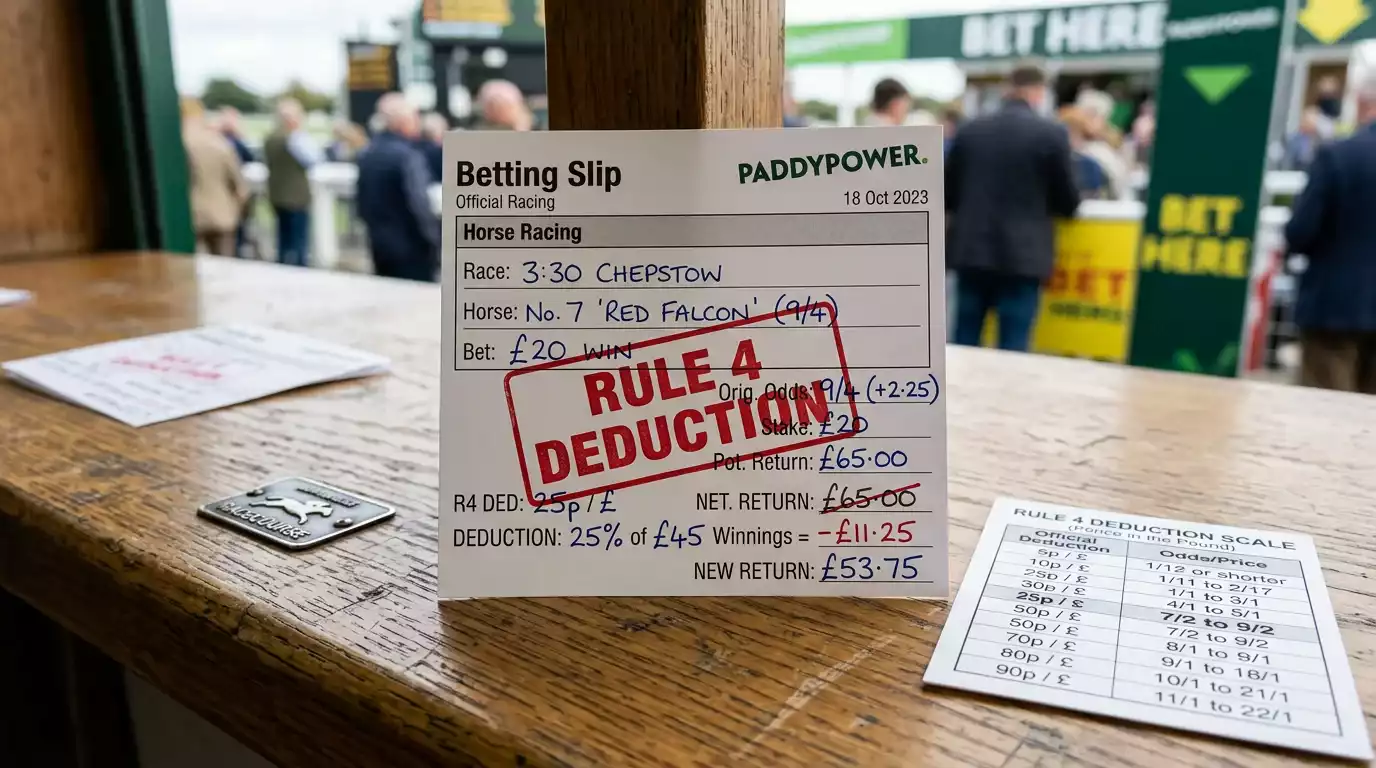
I once backed a 5/1 shot in a seven-runner race, watched it win comfortably, and then discovered my payout was 30p in the pound lighter than expected. The favourite had been withdrawn twenty minutes before the off, Rule 4 had kicked in, and nobody at the track had mentioned it. That was my introduction to the most misunderstood regulation in horse racing betting – a rule that exists for perfectly logical reasons but still manages to blindside punters who haven’t encountered it before.
Rule 4 – formally Tattersalls Rule 4(c) – governs what happens to your bet when a horse is withdrawn from a race after the final declarations but before or at the time of the off. It’s not a bookmaker invention or a sneaky way to reduce your winnings. It’s a mathematical correction designed to keep the betting market fair when a significant runner is removed from a race.
Why Rule 4 Exists and When It Kicks In
Picture a six-runner race where you’ve backed a 4/1 chance. The odds on every horse in the field reflect the number of runners – the market is balanced around the competition between all six. Now remove the 2/1 favourite thirty minutes before the off. Suddenly, every remaining horse has a better chance of winning. The 4/1 shot you backed is now objectively more likely to win than when you placed your bet, but you’re still holding a ticket at 4/1. Without Rule 4, you’d be getting paid at odds that no longer reflect reality – and the bookmaker would be overpaying on every single bet in the race.
Rule 4 corrects this by applying a deduction to your potential winnings based on the price of the withdrawn horse at the time of withdrawal. The shorter the price of the non-runner, the bigger the deduction. This makes intuitive sense: removing a 50/1 outsider barely changes the race dynamics, so the deduction is minimal. Removing the odds-on favourite changes everything, so the deduction is substantial.
The rule applies across all 59 licensed racecourses in the UK and is universally adopted by every licensed bookmaker. It triggers automatically – you don’t get asked, and you can’t opt out. The deduction is applied to your winnings only, not your stake. If your horse loses, Rule 4 doesn’t make your loss any bigger. The GGY generated by UK remote horse racing betting reached GBP766.7 million in the 2024-25 financial year – a market of that scale needs consistent rules for handling withdrawals, and Rule 4 provides exactly that.
The Deduction Scale – From 5p to 90p in the Pound
The deduction scale is fixed and published, so there’s never any ambiguity about what percentage applies. It’s based on the price of the withdrawn horse at the time of withdrawal – not the price when you placed your bet, and not the price of your horse. The scale runs from the smallest deduction to the largest:
A withdrawn horse priced at 14/1 or longer triggers a 5p in the pound deduction. At 10/1 to 14/1, the deduction rises to 10p. At 8/1 to 10/1, it’s 15p. From 6/1 to 8/1, the deduction is 20p. At 5/1 to 6/1, it climbs to 25p. Between 4/1 and 5/1, you lose 30p in the pound. At 3/1 to 4/1, the deduction is 35p. From 5/2 to 3/1, it’s 40p. At 2/1 to 5/2, you face 45p. Between 6/4 and 2/1, the deduction is 50p. From 6/5 to 6/4, it’s 55p. At evens to 6/5, you lose 60p. Between 4/5 and evens, the deduction is 65p. At 4/6 to 4/5, it jumps to 70p. From 1/2 to 4/6, the deduction is 75p. Between 2/5 and 1/2, you lose 80p. At 1/3 to 2/5, it’s 85p. And at 1/4 or shorter, the deduction reaches 90p in the pound – leaving you with just 10% of your potential winnings.
Here’s a worked example. You’ve backed a horse at 8/1 for GBP10. It wins. Normal return would be GBP90 (GBP80 profit plus GBP10 stake). But the 5/2 second favourite was withdrawn after you placed your bet. The Rule 4 deduction for a 5/2 withdrawal is 40p in the pound. Your profit is reduced: GBP80 minus 40% = GBP48, plus your GBP10 stake returned. Total payout: GBP58 instead of GBP90. That’s a significant hit, and exactly why checking for late withdrawals before the off matters if you’re considering adding to your position.
How Rule 4 Affects Each Way, Accumulators, and Forecasts
The deduction applies to both the win and place parts of an each way bet separately. If your horse wins, the deduction reduces the win profit and the place profit independently. If your horse only places, the deduction still applies to the place component – there’s no exemption for the consolation part of the bet.
For accumulators, Rule 4 gets applied to the individual leg where the withdrawal occurred, not to the entire accumulator. If you have a four-fold and one of the races has a Rule 4 deduction, only the returns from that specific leg are adjusted before being rolled into the next selection. The practical impact depends on where in your accumulator the affected race falls and how large the deduction is – a 5p deduction on an early leg barely registers, while a 65p deduction on a late leg can slash your final return by a third or more.
Forecast and tricast bets handle withdrawals differently. If a horse in a Computer Straight Forecast race is withdrawn, the remaining runners’ CSF payout is recalculated automatically – Rule 4 deductions don’t apply because the forecast dividend is determined after the race based on actual starting prices. However, if you’ve taken a fixed-odds forecast, standard Rule 4 deductions apply to your winnings.
Multiple Withdrawals and Void Races
When more than one horse is withdrawn from a race, the deductions stack. If a 3/1 shot and a 7/1 shot are both withdrawn, the combined deduction is 35p plus 20p = 55p in the pound. However, there’s a cap: the total Rule 4 deduction cannot exceed 90p in the pound regardless of how many horses are withdrawn. Your winnings can never be reduced below 10% of their normal value through Rule 4 alone.
If enough horses are withdrawn that the remaining field falls below the minimum number for the race to take place, the race is void and all bets are returned as stakes. This is relatively rare but does happen, particularly in smaller fields where a couple of morning withdrawals can leave fewer runners than the race conditions require.
One scenario that generates confusion is when a withdrawal happens after you’ve placed a bet but before the official “day of race” market opens. If the withdrawal occurs during the ante-post period, Rule 4 doesn’t apply – you simply lose your ante-post stake under the standard ante-post terms. Rule 4 only governs withdrawals that happen within the day-of-race betting window.
Can Rule 4 reduce my winnings to zero?
No. The maximum Rule 4 deduction is 90p in the pound, which means you will always receive at least 10% of your original profit plus your returned stake. Even in extreme cases with multiple withdrawals, the combined deduction is capped at 90p.
Does Rule 4 apply to ante-post bets?
No. Ante-post bets carry their own risk – if your horse does not run, you lose your entire stake with no refund. Rule 4 deductions only apply to bets placed during the day-of-race market, after final declarations have been made. The two systems are mutually exclusive.
Created by the ”Horse Racing Game Betting” editorial team.