Tote Pool Betting in Horse Racing – How the UK’s Pari-Mutuel System Pays Out
 Available in US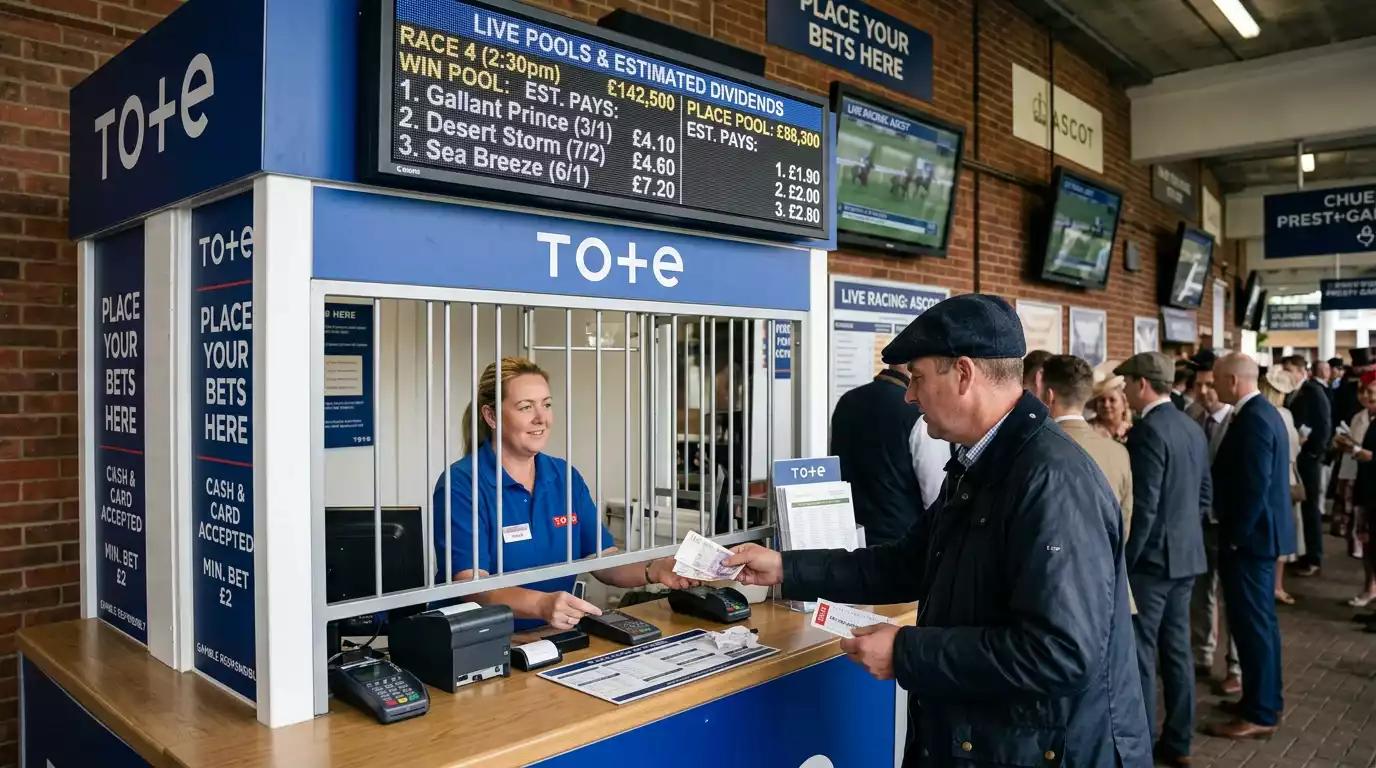
The first Tote bet I placed deliberately – not just by accident at a racecourse window – was a Placepot at Newmarket on Guineas weekend. I spent GBP2, picked six horses across six races, and needed each one to place. The first five obliged. The sixth, a 7/2 shot in the last, ran third. The Placepot that day paid GBP340 to a GBP1 stake. That GBP680 return from a GBP2 bet was the moment I stopped ignoring the Tote and started taking pool betting seriously as a complement to fixed odds.
The Tote is the UK’s pari-mutuel betting system, and it operates on fundamentally different principles from the bookmaker market. Only about 5% of UK horse racing betting turnover passes through the pools, with the rest going to fixed-odds bookmakers. But that 5% contains some of the most interesting – and occasionally most lucrative – betting opportunities in racing, particularly for punters who understand when pool dividends are likely to exceed fixed-odds returns.
Pari-Mutuel vs Fixed Odds – How the Tote Pool Differs
With a fixed-odds bookmaker, you know your potential return the moment you place your bet. Back a horse at 8/1 for GBP10 and, if it wins, you receive GBP90 regardless of what anyone else does. The bookmaker has set the price and accepted the risk.
The Tote works differently. All bets on a given pool (win, place, forecast, etc.) go into a shared pot. The Tote takes a percentage – the “takeout” – typically around 14-28% depending on the pool type. The remainder is distributed among the winning bets in proportion to their stakes. You don’t know the exact dividend until after the race, because it depends on how much money is in the pool and how it’s distributed across the runners.
This creates a dynamic where popular horses – those that attract heavy Tote support – often pay less than the fixed-odds SP, while unpopular horses can pay significantly more. If the crowd backs the favourite heavily in the Tote pool, the dividend on the favourite will be compressed. But the outsider that nobody fancied in the pool might pay a dividend far exceeding its fixed-odds price, because fewer winning tickets share the pot.
The takeout is the Tote’s equivalent of the bookmaker’s overround, but it’s applied transparently to the pool rather than hidden within the individual prices. A 16% takeout on the Win pool means 84p of every pound wagered is returned to winning bettors. The bookmaker’s equivalent – often 15-20% overround across the whole book – achieves a similar result through less visible means.
Tote Bet Types – Win, Place, Exacta, Trifecta, and More
The simplest Tote bet is the Win pool: pick the winner. The Place pool pays if your horse finishes in the placed positions (same definition as each way placing). Both work identically in structure to their fixed-odds equivalents, with the dividend calculated after the race from the pool.
The Exacta is the Tote’s forecast bet – predict the first two finishers in the correct order. The Trifecta extends to the first three in order. Both pool dividends can be dramatically different from their fixed-odds CSF and Computer Tricast equivalents, because the pool reflects the specific pattern of money wagered rather than a formula based on starting prices.
The Swinger is unique to the Tote: pick two horses to finish in the first three, in any order. It’s a more forgiving bet than the Exacta because you don’t need to get the exact finishing order right, and either of your two selections can finish first, second, or third. The Swinger often appeals to punters who can identify two horses likely to be involved in the finish without being sure which will beat the other or where the third-place finisher will come from.
The Jackpot requires picking the winner of each of the first six races at a nominated meeting. The Scoop6 selects winners across six designated races from different meetings on a Saturday. Both are accumulator-style pool bets where the prize fund can roll over when nobody wins, producing lottery-scale payouts from modest stakes. Scoop6 dividends have exceeded GBP1 million.
Placepot and Scoop6 – The Big Pool Bets
The Placepot is the Tote’s flagship multi-race pool and one of the best value bets in horse racing for regular punters. It requires you to pick a horse to place in each of the first six races at a meeting. Note: place, not win. In a typical six-race card, you need six horses to finish in the places – first, second, or third in most races, first and second in smaller fields.
The beauty of the Placepot is in the permutation structure. You can select multiple horses in each race (known as “bankers” for single selections and “perms” for multiples), which increases your number of lines. Two selections in one race and three in another means six lines – six Placepot bets. The cost is your unit stake multiplied by the number of lines. At GBP1 per line, a modest perm costs GBP6-12 and gives you coverage across the card.
Placepot dividends vary wildly depending on the difficulty of the card. An easy card where favourites place in every race might pay GBP5-15 to a GBP1 unit. A tricky card with upsets can pay GBP200-500 or more. The skill lies in identifying which races are likely to produce surprises and including multiple selections in those races while banking the more predictable ones.
Remote horse racing betting generated GBP766.7 million in GGY in 2024-25, and pool betting represents a small but distinctive corner of that market. The Placepot, in particular, has a loyal following among regular racegoers and offers a way to engage with an entire card for a small outlay – something that fixed-odds betting, with its race-by-race structure, doesn’t replicate as efficiently.
When Pool Betting Outpays Fixed Odds
The question every Tote punter asks is: when does the pool pay more than the bookmaker? The answer isn’t random – it follows a predictable pattern based on market dynamics.
Pool dividends tend to exceed fixed odds when a well-fancied horse wins but the Tote pool was skewed by heavy support for a different horse. If the market favourite is also the Tote favourite, the Win dividend will be similar to or less than the SP. But if casual money has been piled on a “name” horse – perhaps a runner from a high-profile trainer or a horse with a catchy name – while the true favourite receives less pool support, the dividend on the true favourite can exceed its fixed-odds price.
This pattern is strongest at big meetings attended by casual racegoers – exactly the meetings where Tote pools are largest and most liquid. Festival days, bank holiday meetings, and summer Saturdays attract punters who bet on sentiment rather than form, and their money inflates the dividends available on horses they’ve overlooked.
I use the Tote Win pool as a complement to fixed odds, not a replacement. When I can see that the Tote pool is developing in a way that suggests my selection will pay a bigger dividend than the SP, I’ll split my stake between the fixed-odds bookmaker (with BOG) and the Tote. This dual approach captures the upside of both systems – if the SP is higher, BOG triggers on my fixed-odds bet; if the Tote dividend is higher, my pool bet outperforms. It’s a simple strategy that treats the pricing mechanism itself as a variable rather than a given.
Is the Tote dividend always better than fixed odds?
No. The Tote dividend is often similar to or lower than the fixed-odds SP for well-backed horses, because heavy pool support compresses the payout. However, for less popular runners or when the pool is skewed by casual money on other horses, the Tote dividend can significantly exceed fixed-odds returns. The outcome depends on the distribution of money in the pool relative to the fixed-odds market.
Can I place Tote bets online or only at the racecourse?
You can place Tote bets both online and at the racecourse. The Tote operates its own website and app where all pool bet types are available. Many major bookmakers also offer access to Tote pools through their own platforms. On-course, Tote windows are available at all UK racecourses. The dividend is the same regardless of where you place the bet, as all bets feed into the same pool.
Published by the Horse Racing Game Betting team.